
The short answer
Eligible drifting distance earns points, weighted by angle and speed.
In the verified Drift Zone calculation, each scoring update adds the distance the car traveled multiplied by a base points value, an angle factor and a speed factor. The game must also accept the car's angle, position and other eligibility conditions. A large slide alone does not establish that points are being awarded.
The angle factor reaches its maximum at about 59.4°. Within the accepted angle window, going beyond that does not increase the angle factor. A 40° slide already receives about 90.2% of the maximum angle factor. That percentage describes one part of the calculation, not your share of a possible final score.
Scope: the formula and angle profile were checked on both PC editions. The full numeric scoring example uses settings captured on September 12; the angle profile was checked again on October 6. See the evidence and its limits.
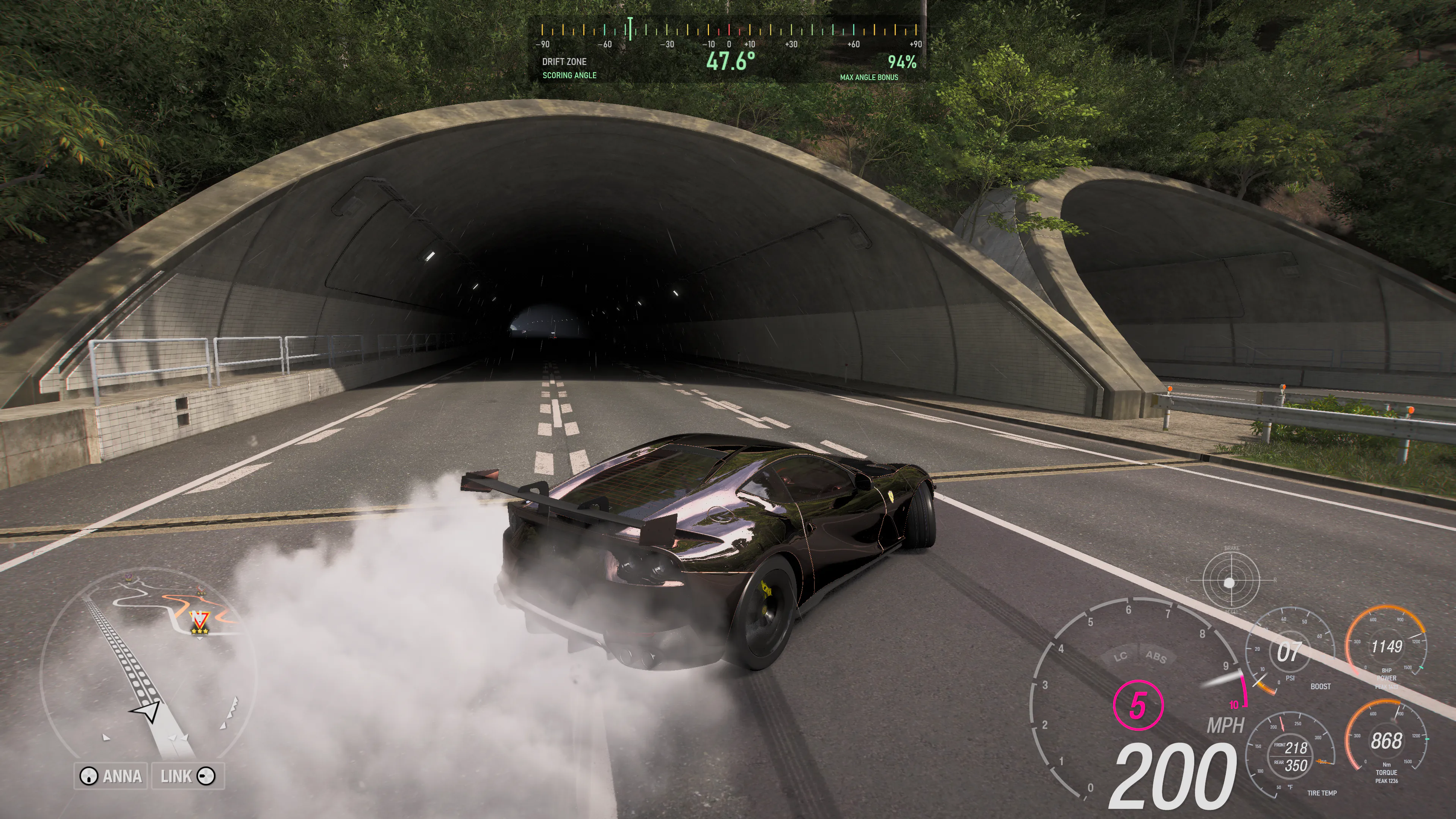
01 · Angle
How much does drift angle affect your score?
The recovered calculation measures the angle between the car's forward direction and its three-dimensional velocity. In the car's local axes, it is acos(vforward / |v|). This is not steering-wheel angle or the slip angle of an individual tire. Vertical motion contributes, so a jump or a steep change in direction can differ from a flat, top-down sideslip measurement.
The captured profile accepts angles from 10° through 110°, including both endpoints. Its angle factor rises linearly from 30 at 10° to 40 at approximately 59.4°, then stays at 40 through 110°. Outside the window, the angle eligibility check fails.
Explore the verified angle factor
More angle helps — up to a ceiling
This explains the angle calculation. It does not detect a live zone or predict a complete score. Speed, position and the other eligibility checks still matter.
| Angle | Factor | Share of maximum |
|---|---|---|
| 10° | 30.00 | 75.0% |
| 20° | 32.02 | 80.1% |
| 30° | 34.05 | 85.1% |
| 40° | 36.07 | 90.2% |
| 47.6° | 37.61 | 94.0% |
| 59.4° | 40.00 | 100.0% |
| 80° | 40.00 | 100.0% |
| 110° | 40.00 | 100.0% |
Why 100% does not mean a perfect drift
The gauge divides the current angle factor by 40 and rounds down to a whole percentage for display. The explanatory table above rounds to one decimal place. At 10°, that is 30 ÷ 40 = 75%. At 59.4°, it is 40 ÷ 40 = 100%. A 100% reading says that the angle factor has reached its ceiling. It says nothing by itself about the speed factor, eligible distance or whether a zone is active.
Holding 80° instead of 59.4° gives the same angle factor in this profile. Holding 40° gives about 90.2% of that factor. Moving from 40° to the ceiling is therefore about a 10.9% increase in the angle component, with the other factors held constant—not a guaranteed 10.9% improvement in a complete run.
02 · Points
The Drift Zone points calculation
For an eligible scoring update, the recovered code accumulates:
The factors can change every update. A zone total is the sum of accepted increments, subject to the game's zone state and resets. This is why a single screenshot, peak angle or speedometer reading cannot reconstruct a whole run.
A worked example over 100 metres
The September 12 captured configuration used a base value of 0.1, an angle factor of 30–40, and a speed factor of 45–50 remapped across 10–50 mph (about 16.1–80.5 km/h). The remap clamps at its endpoints. Those speed endpoints are not, by themselves, minimum or maximum speeds at which scoring is allowed.
| Angle / travel speed | Calculation | Points |
|---|---|---|
| 40° / 30 mph | 100 × 0.1 × 36.073 × 47.5 | ≈ 17,135 |
| 59.4° / 30 mph | 100 × 0.1 × 40 × 47.5 | 19,000 |
| 59.4° / 50 mph | 100 × 0.1 × 40 × 50 | 20,000 |
| 59.4° / 80 mph | 100 × 0.1 × 40 × 50 | 20,000 |
These examples assume that every increment passes all eligibility checks. They are useful for understanding the equation; they are not a promise of a particular score from driving 100 m. The full configuration was not re-sampled in October.
03 · Speed and distance
Does driving faster always give more drift points?
Separate points per metre from points per second. Once the captured speed factor reaches its ceiling, a metre at 80 mph has the same speed weighting as a metre at 50 mph. The faster car still travels more metres each second.
At the maximum angle and speed factors in the example profile, 50 mph (22.352 m/s) gives about 4,470 points per second. At 100 mph (44.704 m/s), the same arithmetic gives about 8,941 points per second. Both give 20,000 points over the same 100 m of fully eligible travel. Equal time and equal distance are different comparisons.
Wheelspin is not extra traveled distance
The scoring calculation uses the car's velocity, not driven-wheel rotation. Spinning the tires faster does not make the car cover more ground. In Wisp, the wheel-indicated speedometer can rise far above travel speed during a slide; that larger number must not be substituted into the scoring formula. See how wheel speed differs from vehicle speed.
What about taking a wider line?
The equation weights eligible distance traveled. A longer path can contain more such distance, but only while its increments pass the zone's position, progression and other checks. The recovered equation does not establish a universal "take the widest line" rule, and the eligibility logic prevents treating arbitrary movement as guaranteed extra points.
04 · Eligibility
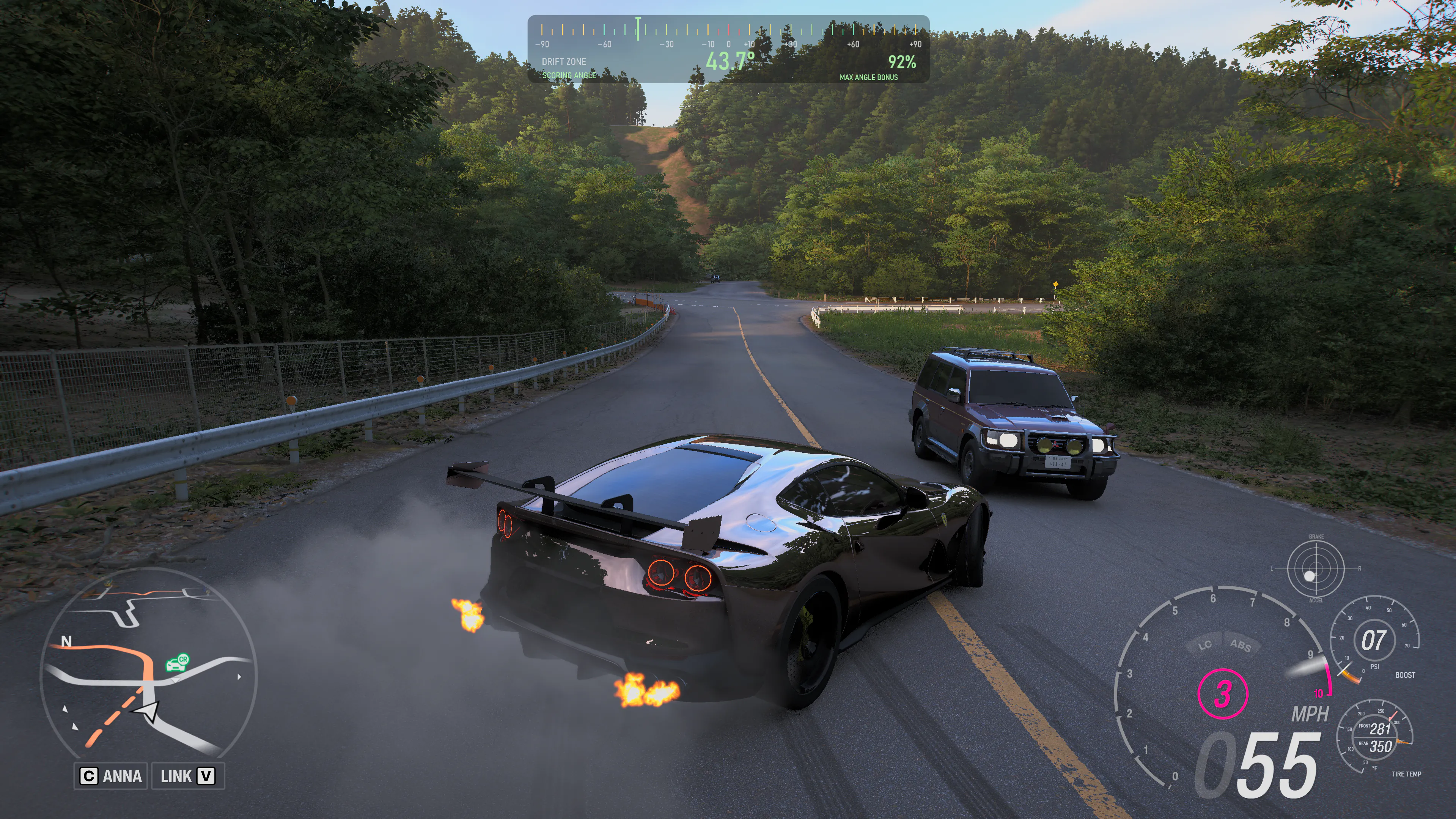
Why can the score stop while the car is still sideways?
The multiplication runs inside a larger set of checks. Our analysis establishes these boundaries:
- Angle must be in range. Below 10° or above 110° fails the captured angle check.
- Zone state and progression matter. The recovered update checks zone state and route progression. The September configuration included a progression-rate threshold of 0.002; its route units were not established, so it must not be described as a road-speed limit.
- A wheel-related eligibility check exists. The September configuration required a count of at least two. The calls that classify those wheels were not fully decoded; "two tires touching asphalt guarantees points" would overstate what is known.
- Accumulation can stop or reset. Native state transitions must be accounted for when reconstructing a total. We have not exhaustively mapped every collision, rewind or zone-failure scenario.
A green or 100% angle reading is therefore compatible with no points being added. Wisp's angle guidance is not a substitute for the game's actual score counter.
05 · Different scoring systems
Drift Zones, Drift skills and Drift Attack are different counters.
Drift and E-Drift in a skill chain
The on-screen Drift or E-Drift skill award and the skill-chain multiplier belong to the skill system. The equation recovered here is for the Drift Zone counter. It does not multiply the zone increment by the on-screen skill-chain multiplier. A growing skill chain is not evidence of an equivalent increase in zone points.
This guide does not claim to decode every skill award, perk or combo threshold. Those need separate evidence.
Drift Attack and Clipping Zones
The official Drift Attack announcement says it uses drift scoring like Horizon Drift and Drift Zones, with an additional points boost while drifting inside Clipping Zones. The launch article describes the goal as the highest drift score in a single lap.
We have not verified the numeric clipping boost or all Drift Attack rules. Do not apply the ordinary-zone examples as a complete Drift Attack score calculator, or treat its clipping bonus as proof of a hidden ideal-line multiplier in ordinary Drift Zones.
Common questions
FH6 drift scoring questions
What is the best drift angle for points?
About 59.4° is where the verified angle factor reaches its maximum. It is an angle-factor ceiling, not a universally best angle for an entire corner or a guarantee of the highest zone total.
Does 90° score more than 60°?
Not through the verified angle factor: both are on its plateau. With equal eligible distance, equal speed and all other conditions equal, that component is identical.
Do AWD, RWD, horsepower or steering input have their own multiplier?
The recovered increment has no separate drivetrain, horsepower or steering-input coefficient. These can change the motion of the car and how much eligible distance it covers. This finding is limited to the recovered Drift Zone equation; it is not a claim that every drift activity uses identical rules.
Is 10 mph the minimum speed for scoring?
That was the lower endpoint of the sampled speed-factor remap. It does not establish a minimum scoring-speed rule. Wisp also hides its gauge at very low speed for readability; that display choice is separate from the game's scoring checks.
Does this apply to Steam and Xbox?
The same scoring code and angle profile were checked in the Steam and Xbox app / Microsoft Store Windows PC editions. Xbox console binaries were not inspected, so we do not present the PC checks as console verification.
Evidence and limits
How these findings were checked
- September 12, 2026: scoring code, settings and an active score capture. Read-only inspection of Steam FH6 6.440.853.0 identified the angle calculation, remaps, eligibility branches and accumulation formula. Across 2,158 active-zone samples spanning about 22.87 game seconds, the observed score rose by 94,015.2 points. Reconstructing that partial run gave 94,085.3 points, about 0.075% above the observed gain, conditional on the captured native eligibility and reset states. That is evidence for this path, not an exhaustive validation of all zones and game modes.
- October 6, 2026: both PC editions rechecked. The scoring update, eligibility, angle, remap and accumulator code matched the retained reference in Steam FH6 6.461.691.0 and Xbox app / Microsoft Store FH6 3.461.691.0. Twenty sampled angle configurations on each edition matched the five angle-profile values. These were parked, read-only checks, not new active scoring runs.
- October 9, 2026: guide reviewed against those records. The speed-factor endpoints, base points value and wheel-count setting were not re-sampled in October. No claim here depends on a new live driving test. Future game updates can change code or configuration.
The displayed ceiling of 59.4° rounds the captured floating-point value 59.400001525878906°. Small differences from rounding, sampling and state transitions matter when trying to reproduce an exact game total.
Sources you can inspect
- Dated Wisp evidence summary and example inputs — the scope, sampled constants and limits used for this page.
- Wisp's published angle calculation and angle-profile tests — reproducible guidance logic, not the game's source code.
- Forza: Drift Attack announcement — official description of Clipping Zones.
- Forza: Series 5 launch — official single-lap Drift Attack objective.